

Drone Insurance
Drone and Liability Insurance protects against physical loss or accidental damage of the drone for commercial operations, and legally required third-party liability insurance.
At Expat Insurance, we help secure coverage to deliver reliable protection for everyday use and unexpected incidents.
Who Needs Drone Insurance?
Drone Insurance is relevant for businesses and individuals who operate drones for commercial, professional, or work-related purposes. This includes activities such as aerial photography, surveying, inspections, building cleaning, or any situation where …
Read More
a drone is used outside purely recreational flying.
Anyone operating a drone in a business context is exposed to risk — not only to the equipment itself, but to third parties, property, and the surrounding environment. Even a brief loss of control, technical failure, or operator error can result in damage or injury, leading to potential legal and financial consequences.
Drone Insurance is especially important where drones are flown near buildings, people, vehicles, or infrastructure. In these environments, liability exposure can escalate quickly, making insurance a critical safeguard rather than an optional add-on.
Possible Pitfalls We Help You Avoid
One pitfall is assuming a Business Insurance or Personal Insurance policy automatically covers the drone or any liability. Drones are specifically excluded from Business Insurance and Liability policies, leaving operators unknowingly exposed. A …
Read More
dedicated Drone and Liability Insurance policy is required.
Another risk is underestimating liability exposure. Even a small drone can cause significant damage or injury, and claims can quickly exceed what individuals or businesses are prepared to handle personally. Without proper cover, legal costs alone can become substantial.
Expat Insurance also help clients avoid policies that fail to reflect how drones are actually used. Coverage needs to align with whether flights are commercial, where they occur, and the level of exposure involved — not just the value of the equipment.
Why Work With Expat Insurance?
Drone Insurance provides public and business liabilities, equipment protection, and business risks, making it easy to misunderstand or misconfigure. Expat Insurance helps clarify what needs to be insured — and just as importantly, what does not. We …
Read More
assess how and why the drone is used, explain where risks typically arise, and ensure the policy reflects real-world operations. Our role is to remove uncertainty and make sure coverage performs as expected if an incident occurs.
By working with Expat Insurance, you gain clarity, appropriate protection, and confidence that your drone activities are properly insured — without relying on assumptions or incomplete cover.
What Does Typical Cover Include?
Drone and Liability Insurance is designed to protect the drone against physical damage, and the operator or business from third-party liability, and operational risks whilst operating the drone. This commonly includes cover for accidental damage caused …
Read More
by the drone to third party property, bodily injury or other assets during a flight.
Policies should include liability cover if a drone causes injury to a third party or results in a claim for damages. This is particularly important as liability claims can arise even when no intent or negligence is involved — simply from an accident or incident occurring during operation.
Depending on the structure of the policy, Drone Insurance can also cover loss or damage to the drone itself, helping reduce the financial impact of crashes, technical failures, or unforeseen incidents that render equipment unusable.
Third-Party Liability and Damage on the Ground
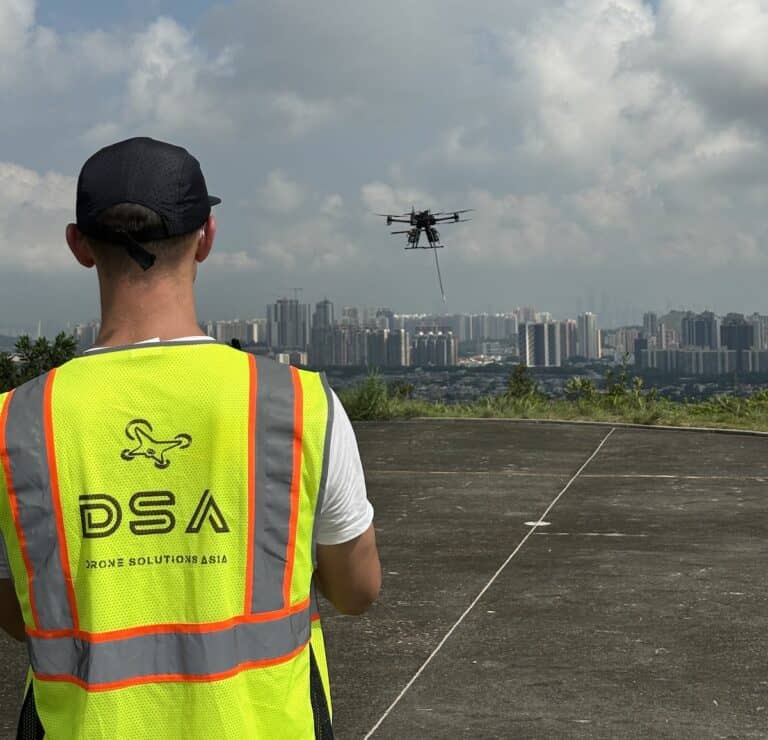
Almost every serious question about drone insurance comes back to one exposure: what happens when the aircraft is no longer where you meant it to be. A drone that drops out of a flight over a construction site, a promenade or a car park does not damage itself in isolation. It lands on somebody, or on their property, and the liability that follows is the part with no natural ceiling.
Third-party liability is therefore the foundation of any drone insurance arrangement, and the piece that most operators buy first. It answers injury you cause to a person outside your business and physical damage you cause to property that is not yours. Hull damage to the aircraft itself is a separate question, and one we deal with further down the page.
The liability exposure in Hong Kong is unusual in one respect: density. There is very little airspace over this city that is not also over people. A flight that would be routine over open farmland is, here, a flight over a pedestrian walkway, a podium garden or a live carriageway. That does not make commercial drone work impractical — it makes the liability coverage limit a decision worth taking seriously rather than defaulting to the cheapest option available.
What that limit should be depends on where the aircraft actually flies. An operator surveying a rooftop in an industrial district carries a different profile from one filming a wedding on a crowded waterfront, even with identical equipment. We work the limit up from the flying you actually do, not down from a standard figure, and we would rather have that conversation before the policy is bound than after a claim.
One thing worth stating plainly: a general business policy will almost never answer a drone claim. Most modern liability insurance wordings exclude aircraft, and a small unmanned aircraft is still an aircraft for that purpose. Operators who assume their existing business insurance quietly covers the drone are usually wrong, and it is a cheap thing to check.
What Insurance Coverage a Commercial Operator Needs
Commercial drone work in Hong Kong sits under the Civil Aviation Department’s regime for small unmanned aircraft, which sorts operations into categories by the weight of the aircraft and the nature of the flight. What the rules require of you — registration, competency, and whether third-party liability insurance is mandatory rather than merely sensible — depends on which category your flying falls into. We check that against the current requirements for each operator rather than working from a figure in an article, because the detail moves.
Beyond the statutory position, the insurance coverage that commercial drone operators actually need tends to have four parts. Liability for injury and property damage is the first. Hull cover for the aircraft is the second. Payload cover for the camera, sensor or lidar unit carried is the third, and it is often worth more than the airframe. The fourth is the awkward one: cover for the loss of the data or footage the flight existed to capture.
Which of the four matter depends on the work. A surveyor flying weekly for a contractor needs hull and payload cover because the equipment is a working asset. A production company flying twice a year needs liability far more than it needs hull. There is no single package that suits both, and any broker offering one has not asked what you fly or how often.
Where drone operations form part of a larger business, it is usually better to place this alongside the rest of the programme rather than in isolation. The overlaps with general liability and, for firms giving professional advice off the back of the flight data, with professional indemnity, are easier to see when the wordings sit on the same desk.
One practical note on paperwork. Underwriters ask for the operator’s qualifications, an outline of the typical flight profile, and the value of each aircraft and payload. Having that ready shortens the process considerably, and it usually improves the terms — an insurance company reading a complete picture of well-run drone operations prices it differently from one filling gaps with assumptions.
Let's Get Your Insurance Done Right
Speak with Expat Insurance to arrange your Drone Insurance — so you can operate confidently, knowing your equipment and liability are properly protected.
We learn About Your Business.
We evaluate how the drone is to be used, commercially, where, and if payloads are included etc.
We clarify your protection options.
We explain the difference between first-party (your losses) and third-party (client claims) coverage.
We negotiate better terms.
We ensure your policy includes incident response support, low deductibles, and broad coverage.
We’re with you for the long haul.
From renewals to policy reviews, we don’t disappear after the sale.
CALL US TODAY
How Can We Help you?
Fill in your details, we’ll be in touch to answer your questions. No hard sell. Just the friendly help you need. We’ll get back to you to you within 24 hours. Or on the next business day if it’s now after hours.
Insurance Cost and What Moves the Premium
The insurance cost of a drone policy is driven by fewer things than people expect, and the equipment is not the biggest of them. Underwriters look first at what the aircraft is used for, second at where it flies, and only then at what it is worth. A hobby flight over open water and a commercial drone survey over a live worksite can involve the same airframe at very different prices.
The factors that move a premium most are the liability limit selected, whether hull cover is included, the value of the payload, the operator’s qualifications and flight hours, and the geography of the flying. Night operations, flights beyond visual line of sight and work over crowds all sit outside the standard assumptions and are priced accordingly — where they can be written at all.
Annual policies are the norm for anyone flying regularly, and short-period cover exists for one-off productions. Buying by the flight looks cheaper on a single job and is almost always the more expensive way to run a business that flies monthly.
Liability Coverage Limits in Practice
Choosing a liability coverage limit is the decision most operators rush. The useful test is not what feels large, but what the worst realistic day looks like: the aircraft comes down in the busiest place your flight plan takes it over, and somebody else’s medical costs, property damage and legal expenses follow. Drone insurance typically handles legal expenses alongside the damages themselves, which matters because the defence costs on a contested injury claim can rival the settlement.
Clients who fly commercially in dense districts generally settle on a limit well above the statutory minimum, and clients whose work is confined to controlled industrial sites often sit lower. Both are defensible. What is not defensible is choosing a limit because it was the first number on a comparison page.
Choosing an Insurance Provider in Hong Kong
Drone risk is specialist. It sits with aviation underwriters rather than general commercial ones, and the number of carriers writing it properly in this market is small. An insurance provider that treats a drone as an odd piece of business equipment will produce a policy that reads well until it is tested; one that treats it as an aircraft will ask about flight hours, competency and operating limitations, which is the sign you want to see on the proposal form.
The questions worth asking any insurance company before you place the risk are consistent. Does the cover follow the operator or the airframe? Are training flights included? What happens to the liability position if a flight breaches an operating limitation by accident? Is the payload insured on the same basis as the aircraft, or on a separate and much narrower one? Is cover suspended if the pilot’s competency certificate lapses mid-term?
Insurance Programs for Fleets and Repeat Operators
Operators running several aircraft benefit from being written as a fleet rather than as a stack of single policies. Fleet insurance programs let aircraft be added and removed during the year, cover pilots by class rather than by name, and usually cost less in total than the same airframes insured individually. They also produce one renewal date instead of five, which is a quieter benefit that busy operators notice.
Our role as broker is to put the risk in front of the carriers that actually write it, and to translate between how you describe the work and how an aviation underwriter reads it. Those are not the same language. An operator who says “we do property photography” and an underwriter who hears “low-level flight over occupied residential buildings” are describing the same services, and the gap between the two descriptions is where wordings go wrong.
We Ensure Professional Insurance Services
Need Other Insurance Products?
Medical Insurance
Comprehensive international medical cover for individuals, families and businesses — hospital, surgical, maternity, wellness, outpatient and dental.
Corporate / Group
Flexible group medical and life plans that promote employee well-being, support long-term business success and improve staff retention in Hong Kong.
Business Insurance
Cover for losses from damage to contents, property and stock plus income loss, public liability and Employees' Compensation for business resilience.
Property Insurance
Protect your home and contents from fire, theft, typhoons, water damage, accidental damage and public liability for your complete peace of mind.
Life Insurance
Long-term financial security for your family — covering debts, mortgages and children's education so the unexpected never derails your plans in Hong Kong.
Our Simple Process
Talk to us about your needs
We learn your budget, lifestyle, and health priorities.
Compare your best options
We present suitable plans side-by-side in clear language.
Get you insured quickly
We handle the applications, forms, and negotiations.
Stay with you long-term
Each year, we review your policy and help with claims.
testimonials
Why Our Clients Are Satisfied
Our service consistently exceeds expectations. But don’t just take our word for it—here’s what our customers say!


Hull Damage, Payload and Total Loss
Hull cover answers damage to the aircraft itself. It is the part operators think of first and the part that matters least in a genuinely bad outcome, because the liability is what threatens the business while the hull is merely expensive. That said, for anyone whose income depends on flying, a grounded aircraft is lost revenue as well as a repair bill.
Most hull wordings respond to accidental damage in flight, on the ground and in transit, subject to an excess that is usually a meaningful percentage of the insured value rather than a flat sum. Total loss is settled on an agreed value where the policy is written that way, which is worth insisting on: a fly-away over water leaves nothing to inspect, and an agreed value avoids a valuation argument at the worst possible time.
Payload is where the money usually is. A mid-range airframe carrying a thermal sensor or a cinema camera can be worth several times the aircraft, and standard hull cover does not automatically extend to it. The weight the aircraft is certified to carry, the value of what is bolted to it, and whether that equipment is owned or hired all need to be on the proposal rather than assumed.
Battery-related loss deserves a line of its own. Lithium packs are the most common cause of ground damage we see, they are excluded or sub-limited on some wordings, and the storage conditions a policy expects are often stricter than what a working operator actually does. It is worth reading that clause before renewal rather than after a fire.
Insurance Coverage for Recreational Flying
Recreational flying is a different conversation. If you fly a sub-250g aircraft in permitted areas for your own enjoyment, you do not need drone insurance in the sense a commercial operator does — but you are still liable for what the aircraft does, and household policies rarely help. Many exclude aircraft outright, and those that do respond often stop at the boundary of your own property.
For recreational pilots the practical questions are whether personal liability follows you into the air at all, and what happens if the aircraft is stolen or lost. Some home contents arrangements extend to portable equipment away from the home and some do not, and the limit is frequently lower than the drone is worth. It costs nothing to check the wording you already hold before buying anything new.
Manufacturer schemes such as DJI Care Refresh sit in a different category again. They are repair-and-replacement programmes for the aircraft, not liability insurance, and they will not answer a claim from somebody your drone lands on. Holding DJI cover and assuming you are insured is one of the more common misunderstandings we correct.
Where recreational flying starts producing income — a paid wedding, a few property listings, a favour for a friend’s business — the position changes immediately. That is commercial use, whatever the invoice says, and the recreational assumptions stop applying. If you are not sure which side of the line you are on, describe the flying to us and we will tell you.
Illustrative Examples — How the Right Cover Changes the Outcome
An employer scheme can look comprehensive and still cover only part of a large hospital bill. Checking the limits before you need them is what shows whether there is a gap worth closing.
Waiting periods — not price — often decide between two policies that otherwise look the same. Planning ahead of a life change is what keeps the better option open.
Where you want to be treated changes which policy suits you more than most people expect. Cover that stops at the border is a very different product from cover that travels with you.
Commonplace in Hong Kong, these events show how one illness or accident can rapidly become a financial emergency. The outcome often depends on whether the right policy is in place.
Comparing Cover by Type of Operation
The table below sets out how the four parts of a drone policy usually apply across the kinds of flying we see in Hong Kong. It is a starting point for a conversation, not a recommendation — the right answer depends on your aircraft, your flight profile and where the work actually takes place.
| Type of operation | Liability coverage | Hull cover | Payload cover | Usual policy shape |
|---|---|---|---|---|
| Recreational flying, light aircraft | Personal liability, modest limit | Optional | Rarely needed | Annual, low premium |
| Photography and video services | Essential, mid to high limit | Usually worthwhile | Camera value often exceeds the airframe | Annual policy |
| Survey, inspection and mapping | Essential, higher limit for site work | Yes — the aircraft is a working asset | Sensor and lidar value is high | Annual, often a fleet programme |
| Construction and infrastructure flights | Highest limits, contract-driven | Yes | Yes | Fleet programme with named limitations |
| One-off production or event | Essential for the day | Optional | Depends on hired-in equipment | Short-period cover |
Two patterns are worth drawing out of it. First, liability coverage is the constant — it is the one line that appears in every row, because the exposure to other people does not depend on what the flight was for. Second, the further down the table an operation sits, the more the insurance cost is driven by the payload and the contract rather than by the aircraft.
Frequently Asked Questions
Is it worth getting drone insurance?
For anyone flying commercially, yes — the liability exposure is open-ended and a general business policy will almost certainly exclude aircraft. For recreational pilots it depends on where you fly and what you fly over. The honest test is what a bad flight over the busiest place on your route would cost somebody else, because that is the number the policy exists to answer.
What insurance do you need for a drone?
Third-party liability first, always. Then hull cover if the aircraft is a working asset, payload cover if the camera or sensor is valuable, and short-period cover if the flying is occasional rather than routine. Which combination applies depends on whether the flight is commercial, what it carries, and where it takes place.
What type of insurance is needed for drones in Hong Kong?
Commercial drone operations fall under the Civil Aviation Department’s small unmanned aircraft regime, which sorts flying into categories by aircraft weight and operating conditions. Whether third-party liability insurance is a legal requirement rather than a commercial one depends on the category. We confirm the current position for each operator rather than relying on a published figure, because the requirements have changed more than once.
How much does DJI drone insurance cost?
DJI Care Refresh is a manufacturer repair-and-replacement programme rather than insurance, and it is priced per aircraft model as an add-on at purchase. It does not answer a liability claim from somebody your drone injures or whose property it damages. Operators who hold it still need separate liability cover, and we would rather you knew that before a claim than during one.
Does my business policy already cover the drone?
Very probably not. Most commercial wordings exclude aircraft, and a small unmanned aircraft is an aircraft for that purpose. It takes a few minutes to read the exclusion in the policy you already hold, and it is the single cheapest check on this page.
Are training and test flights covered?
Usually, but not always, and the answer varies by carrier. Where an operator is training new pilots in-house it is worth having the position confirmed in writing rather than assumed, particularly if the training flights happen somewhere the commercial flying does not.
What happens if the drone flies away over water?
A fly-away with no wreckage is exactly why an agreed-value hull wording matters. Where the policy settles on agreed value there is nothing to argue about; where it settles on market value at the time of loss, expect a valuation discussion at the worst possible moment. Ask which basis you are buying.
Is the camera or sensor insured with the aircraft?
Not automatically. Payload is frequently a separate item with its own limit, and on some wordings it is excluded entirely unless declared. Since a thermal or cinema payload can be worth several times the airframe, it is worth declaring the equipment properly at inception rather than discovering the gap after a hard landing.
Do you cover flights beyond visual line of sight or at night?
Sometimes, and always as a declared extension rather than a default. Both sit outside standard operating assumptions and are underwritten individually, with the operator’s approvals and flight-hour record forming most of the decision. Tell us at the outset if either applies to your work.
How quickly can drone insurance be arranged?
For a straightforward commercial operator with current qualifications, usually within a few working days once the proposal is complete. Fleet programmes and unusual operating profiles take longer, because they are individually underwritten rather than rated off a table.
Are hired-in aircraft and sub-contracted pilots covered?
This is one of the most common gaps we find. Cover often follows either the operator or the airframe, not both, and a sub-contracted pilot flying your job on their own aircraft may sit outside your policy entirely. Where you routinely bring in outside pilots, the contract and the wording need to agree with each other.
What does the excess look like on a hull claim?
Typically a percentage of the insured value rather than a flat sum, which means the excess on an expensive aircraft is larger than operators expect. It is a lever worth using deliberately: a higher excess on the hull is usually the cheapest way to reduce a premium without touching the liability coverage that actually protects the business.
Does the policy cover flying outside Hong Kong?
The territorial limit is a clause to read rather than assume, particularly for operators taking equipment across the border or on regional jobs. Some wordings follow the aircraft anywhere, some stop at Hong Kong, and some exclude named territories. Where work travels, tell us where before the trip rather than after it.
Protect What Matters With Confidence
Don’t wait until an emergency strikes to realise your coverage isn’t sufficient. With expert and professional guidance from Expat Insurance, you can be certain that your business, health, home, and future are fully protected.
Guides on this
- What the rules actually require: the licensing and cover position for operators in Hong Kong.
- The liability question that follows: what happens if a commercial flight causes a loss.
- The wider commercial cover drone businesses tend to hold: how this fits into a broader policy set.
Read more
Guides on Drone Insurance in Hong Kong
Everything we have written on this cover — what it includes, what it costs, and the questions worth asking before you commit.
Related cover

