
I ask every employer the same question when they tell me they’ve sorted their helper medical insurance: What if your helper needs to see a doctor?
The silence that follows tells me everything.
Most employers in Hong Kong think their helper medical insurance is covered because they’ve ticked the legal requirement box. They’ve purchased Employees’ Compensation insurance, usually for around HKD 400 to 500 per year, and assumed their obligations are met.
They’re wrong.
The GP Visit Reality Check
Here’s what actually happens when your helper gets ill.
If you’ve only bought the legal minimum—Employees’ Compensation insurance—that policy will not cover a visit to a GP. The coverage is limited to work related incidents such as injuries or occupational diseases that occur during employment. It does not cover non-work-related illnesses like the flu or a sprained ankle outside of work.
When your helper wakes up with a fever, you face two choices:
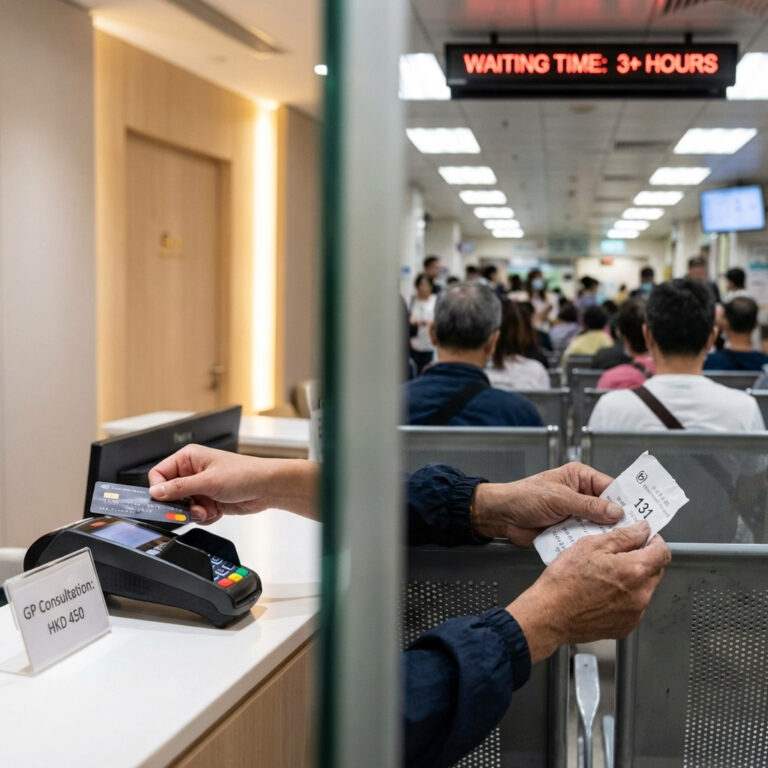
Pay out of pocket for a private doctor visit (which starts at around HKD 400), or send your helper to a government outpatient clinic.
The government clinic costs less. But your helper will be away for half a day instead of a couple of hours. Due to lack of medical staff, waiting times at government facilities are extraordinarily long, regardless of the service needed.
The Maths That Employers Miss
A basic domestic helper insurance policy that includes GP visits costs around HKD 800 per year.
That’s HKD 300 to 400 more than the legal minimum.
A single private GP visit costs that amount.
You’re paying the equivalent of one doctor’s appointment to cover an entire year. Yet employers still choose the bare minimum, then act surprised when they’re writing cheques for medical bills or losing half a day of help because their helper is queuing at a government clinic.
But here’s where it gets more complicated.
Different policies offer vastly different solutions. Some provide token compensation—HKD 200 per visit—which doesn’t come close to covering a normal private clinic visit. Others offer access to a network of doctors with a fixed number of fully covered visits, as long as you use their approved network.
You need to understand what you’re actually buying.
Where Standard Policies Fall Apart
GP visits are just the beginning of your exposure.
Standard helper medical insurance policies also provide some cover for legal liability (if your helper causes damage to third-party property) and dental expenses. But when it comes to serious medical conditions or injuries requiring hospital treatment, these policies are not sufficient.
You face a stark choice: pay tens of thousands of dollars for comprehensive medical insurance, or accept that your helper will use government hospitals.
I can tell you from experience that very few employers are willing to pay for comprehensive medical insurance for their helper. The cost runs into five figures annually. For most families, that’s simply not realistic or acceptable.
So you need to understand what you’re committing to.
The Government Hospital Route
If you’re not paying for comprehensive cover, you’re essentially committing to the government hospital route when something serious happens.
For emergencies, your helper will be treated without waiting time. But for non-emergency conditions requiring surgery or specialist treatment, the waiting times are substantial.
Between July 2023 and June 2024, the median waiting time for stable new case bookings at specialist outpatient clinics for ophthalmology was 55 weeks, with the longest wait extending up to 91 weeks. Common surgical procedures can take anywhere from 8 to 30 months.
Government hospitals offer nominal fees. But the trade-off is time.
Your helper waits. You wait. And during that waiting period, you’re managing a household with reduced help or no help at all.
The Replacement Helper Provision Nobody Understands
Most domestic helper insurance policies include cover for hiring a temporary replacement if your helper is unable to work for medical reasons.
Sounds helpful.
But the cover is usually quite limited, with both a daily limit and an annual limit. The benefit is designed to cover roughly a month of replacement help—enough for minor surgery recovery, but not nearly enough for serious conditions requiring extended recuperation.
Replacement helper expenses up to HKD 10,000 a year sounds generous until you actually need to hire temporary help for several months. Then you realise the benefit provides limited protection.
This is the pattern you’ll notice throughout helper medical insurance: provisions that sound adequate on paper but prove insufficient when you actually need them.
What Your Legal Obligation Actually Requires
Under the Standard Employment Contract (ID 407), you are responsible for providing free medical treatment to your helper. This obligation extends far beyond work-related incidents.
Read that again.
Your legal responsibility is not limited to injuries that occur whilst your helper is working. You must provide free medical care for any reason during the employment period.
Yet Employees’ Compensation insurance—the legal minimum that most employers purchase—only covers work-related incidents. There’s a fundamental gap between what the law requires you to provide and what your minimum insurance actually covers.
Failure to obtain adequate insurance can lead to prosecution, with fines up to HK$100,000 and up to two years’ imprisonment. The seriousness of the obligation stands in stark contrast to how casually most employers approach the decision.
The Medical Inflation Factor
Here’s another reality that catches employers off guard.
Medical cost inflation in Hong Kong is projected to stay high, with private healthcare charges rising faster than general consumer prices. The same operation, scan, or specialist visit costs noticeably more this year than it did a couple of years ago.
Policies you purchased years ago are increasingly inadequate against today’s actual costs.
A short hospital stay or unexpected surgery can easily run into five or even six figures in Hong Kong dollars, especially in the private sector. Standard domestic helper policies have limited coverage for serious hospitalisations, leaving you exposed to costs that have inflated well beyond what those policies were designed to cover.
You’re playing catch-up with a moving target.
The Waiting Period Nobody Mentions
Even comprehensive policies have waiting periods that leave you exposed during the critical first weeks of employment.
The outpatient benefit, hospital and surgical benefit, loss of service cash allowances, and dental benefit under basic protection are typically subject to a 15-day waiting period from the effective date of coverage.
If your helper falls ill in the first two weeks, you’re on your own.
Additionally, most domestic helper insurance policies only provide coverage within Hong Kong. If your helper accompanies you on trips outside Hong Kong, the geographical limitation means you have no coverage. This catches employers unaware when they travel with their helper and something goes wrong.
How to Actually Evaluate a Policy
Stop looking at premium cost as your primary decision factor.
Start asking these questions:
What exactly does outpatient cover include? Is it a token payment or actual coverage? Do you have access to a network of doctors, or are you claiming reimbursement after paying out of pocket?
What are the sub-limits? Policies love to advertise high overall coverage amounts whilst burying restrictive sub-limits in the fine print. A policy with HKD 100,000 coverage sounds impressive until you discover the dental sub-limit is HKD 500.
What’s the claims process? How quickly does the insurer process claims? What documentation do they require? You’ll discover the answers to these questions when you’re stressed and dealing with a medical emergency—not the ideal time to learn your insurer is difficult to work with.
What’s excluded? Pre-existing conditions, specific treatments, certain types of injuries—the exclusions list tells you more about what you’re actually buying than the benefits list does.
What happens after the first month of replacement help? If your helper needs extended recovery time, what’s your plan?
The Real Risk Management Decision
Domestic helper insurance is not a bureaucratic requirement you tick off a list.
It’s a risk management decision that protects both you and your helper.
The question is not whether you can afford better coverage. The question is whether you can afford the exposure you’re accepting by choosing minimum coverage.
A private GP visit costs HKD 400. For less than the cost of two visits, you can upgrade from minimum legal coverage to a policy that actually covers routine medical care. That’s not a difficult calculation.
But you need to go into this decision with open eyes about what you’re actually getting and what gaps remain.
If you’re choosing standard domestic helper insurance rather than comprehensive medical coverage, you’re committing to the government hospital route for serious conditions. That means accepting long waiting times for non-emergency treatment and managing your household with reduced or no help during recovery periods.
That’s a legitimate choice if you understand what you’re choosing.
What’s not legitimate is assuming you’re covered when you’re not, then discovering the gaps when your helper is ill and you’re scrambling to figure out what to do.
What You Should Do Now
Pull out your current helper medical insurance policy.
Read it properly. Not the marketing summary—the actual policy document.
Identify the gaps between what you thought you had and what you actually have. Then decide whether those gaps are acceptable to you or whether you need to upgrade your coverage.
Have a conversation with your helper about what the policy covers and what it doesn’t. Make sure you both understand what happens if she needs medical care.
Document everything. Keep copies of your insurance policy, your helper’s employment contract, and any communication about medical coverage. When something goes wrong, you’ll want this documentation readily available.
And remember: the legal minimum is exactly that—a minimum. It’s not designed to be adequate. It’s designed to be the bare threshold of compliance.
Whether that’s sufficient for your situation is a decision only you can make. But make it consciously, with full understanding of what you’re accepting and what you’re risking.
Because the time to discover your coverage gaps is not when your helper is ill and you’re frantically trying to figure out who pays for what.
How You Get The Protection You Need
Helper medical insurance doesn’t have to be complicated. At Expat Insurance, we help you understand exactly what you’re buying and make sure your policy protects both you and your helper.
No pushy sales tactics. We have a friendly conversation, show you the lay of the land, and explain the different options available. You move forward at your own pace. People choose to work with us because we educate them on their options and help them feel confident about what will work best for them.
We’ll walk you through what GP coverage actually means—whether it’s token compensation or genuine access to a doctor network. We’ll explain the sub-limits so you understand your actual exposure for dental, hospitalisation, and replacement helper costs. And we’ll help you understand the gap between legal minimums and adequate protection, whether you’re hiring your first helper or reviewing existing coverage.
Our goal is straightforward. We want you to have helper medical insurance coverage that works when you need it.
Get in touch with us today. We’ll review your situation, answer your questions, and help you find a policy that provides the protection you need at a price that makes sense.
How We Work With You
Our process is straightforward and designed around your needs.
Step 1: We Talk and Answer Your Questions
We get in touch for a friendly conversation. We’ll explain who we are, what we do, and most importantly, what we’re going to do for you specifically. We’ll answer any questions you have about helper medical insurance.
Step 2: We Educate You on Your Options
We’ll research the market and come up with quotes and options tailored to your situation. Whether you need basic GP coverage, more comprehensive protection, or you’re navigating the choice between standard policies and full medical insurance, we’ll find options that suit your needs. We’ll take you through each option so you understand what’s available.
Step 3: You Decide What Works Best
We’ll meet with you in person or speak on the phone to discuss your options. We’ll explain the differences between policies, help you understand what you’re actually covered for versus what gaps remain, and make sure you’re comfortable with everything. The choice is yours. We’re here to help you make an informed decision.
Step 4: We Stay With You
Once your policy starts, we’re here to help. We’ll meet with you at least once a year to review your coverage, discuss any changes in your situation, and consider any additions you’d like to make. Your needs change over time—whether you’re hiring a new helper or your current helper’s health needs have evolved—and your helper medical insurance should change with them.