


We have had this conversation dozens of times, and very often it is with people in their forties, fifties or sixties, a stage when life already has plenty of moving parts. There may be a mortgage, children still at school, work at its busiest and parents overseas to think about, and now a ring you want to protect properly without adding yet another complication.
Someone gets engaged, or upgrades a ring for a milestone. The ring cost HK$20,000 or more. They want to protect it, so they search for engagement ring insurance in Hong Kong and assume they need a standalone policy built around that one item. It is a natural assumption, and, as we will show, usually not the simplest or the most economical way to do it.
Then they call us and say: “I don’t need home contents insurance. I just want to insure the ring.”
We understand the logic. You are focused on one specific item. You want targeted protection. Why pay for coverage you don’t need?
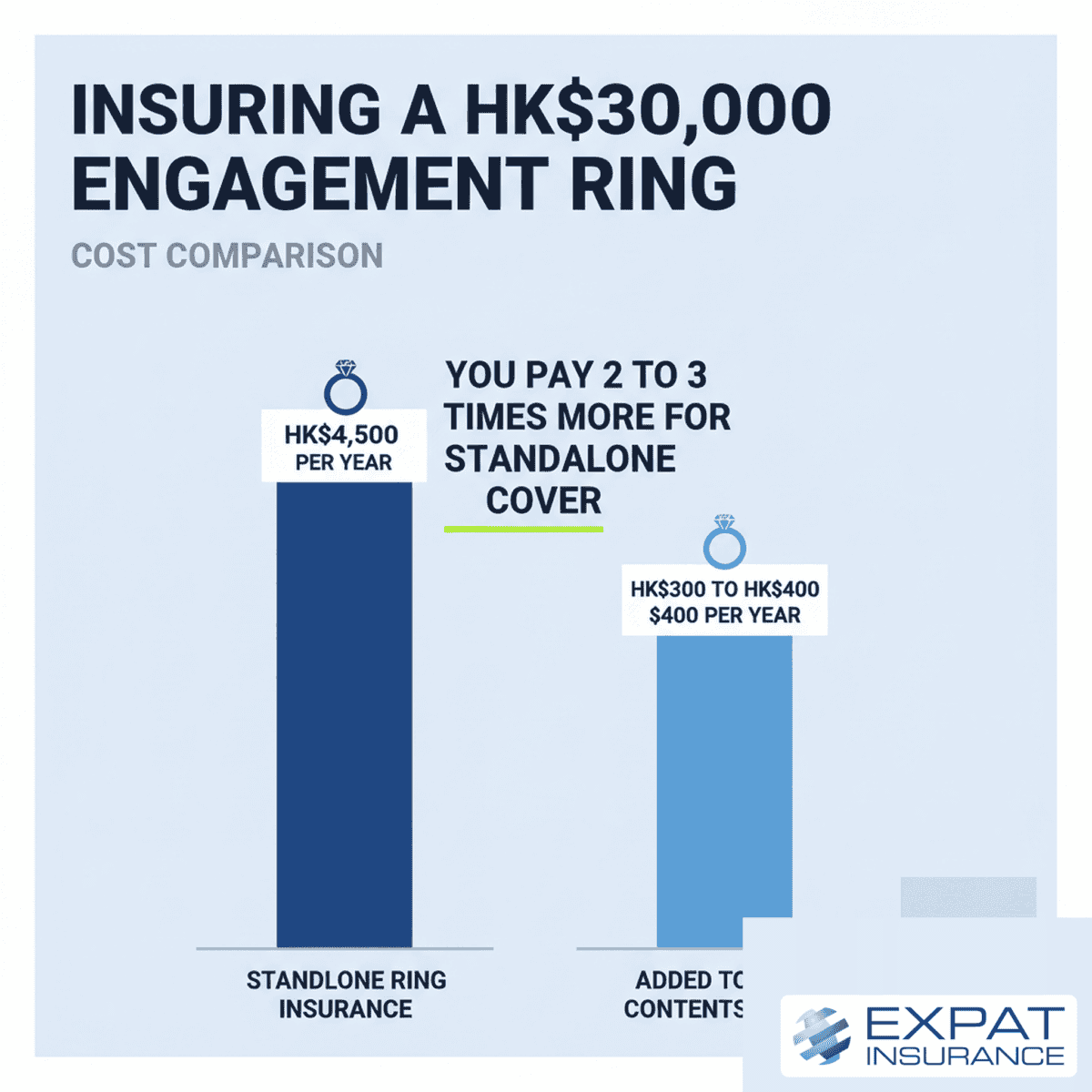
But here is what we have learnt after years of helping people protect their valuables in Hong Kong: standalone valuables cover often costs more than a combined home contents policy that includes your ring. And you miss out on protection you didn’t realise you needed.
Let us walk you through what we have seen work, what doesn’t, and how to make sure you are getting genuine value for your money.
Table of Contents
- The standalone engagement ring insurance trap
- What home contents insurance covers for your engagement ring
- The hidden benefit most renters miss
- How the ring insurance numbers actually work
- What about single-item limits on ring insurance?
- All-risks vs named perils: the wording that matters
- Getting the ring properly valued
- The liability question nobody asks
- What actually happens if you need to claim
- How to get your engagement ring properly covered
- Insuring more than one ring
- Frequently asked questions
- How we work with you
The Standalone Engagement Ring Insurance Trap
Standalone engagement ring insurance exists. You can insure just your ring, and specialist jewellery policies have a genuine place for very high-value pieces whose worth sits far beyond the typical limits of a home policy[9].
The problem for a typical engagement ring is the price.
When you insure a single ring on its own, insurers see higher risk. You are insuring a portable, high-value item that can be lost, stolen or damaged anywhere in the world. There is no broader relationship with you as a customer. The insurer doesn’t know your claims history or risk profile beyond this one item. So they charge accordingly, and standalone policies usually carry a minimum premium that makes small rings expensive to insure on their own.
Compare that to adding the ring as a specified item on a home contents policy. The incremental cost is modest, because the insurer is already covering your home contents and the ring is simply one more item on the schedule.
In our experience, standalone cover for one ring routinely costs a multiple of what the same ring adds to a contents policy. And you are not getting better protection. You are getting less.
What Home Contents Insurance Covers for Your Engagement Ring
Most people think home contents insurance is for furniture and electronics. They don’t realise it covers far more than that.
A standard home contents policy in Hong Kong protects your possessions against theft, fire, water damage and accidental damage. This includes clothing, kitchenware, books, sports equipment and personal items. Leading Hong Kong plans provide household contents cover of up to HK$1,000,000 or more[4].
But here is where it gets interesting for engagement rings.
Standard policies already include some jewellery cover, subject to a per-item cap. MSIG, for example, covers valuables such as jewellery and watches up to HK$15,000 per item[4]. If your ring is worth less than your policy’s limit, it may already be covered under a basic contents policy.
If your ring exceeds that limit, you add it as a specified item. You provide a valuation, pay a small additional premium, and the ring is covered for loss, theft and accidental damage, including outside the home once specified.
The protection mirrors what a standalone policy gives you, but the cost is significantly lower because the insurer is already covering your home contents. The Consumer Council found that HK$1,000,000 of household contents cover was available at annual premiums from HK$500 to HK$1,480, with premiums for the same flat varying nearly twofold between insurers[3]. That variation is exactly why comparing quotes matters. For a fuller breakdown, see our home contents insurance premiums guide.
burglary cases in HK in 2025, the lowest since 1969[1]
typical per-item cap on jewellery under a standard plan[4]
personal liability cover included in one standard HK plan[4]
premium variation found for the same flat across insurers[3]
“I have my annual travel insurance and Hong Kong home insurance from Expat Insurance. Awesome service and easy to deal with unlike most Hong Kong insurance companies.”
Joonas · ★★★★★ verified Google review
How You Get the Engagement Ring Protection You Need
No pushy sales. We compare the standalone route against a contents policy with your ring specified, show you the real numbers side by side, and you decide at your own pace.
The Hidden Benefit Most Renters Miss
If you rent your home in Hong Kong, you might think you don’t need contents insurance. Your landlord has insurance, right?
Yes. But landlord insurance covers the building, the landlord’s own fixtures and contents, and the landlord’s liability. Zurich’s landlord plan, for instance, covers home contents “owned by you”, meaning the landlord, and it does not extend to the tenant’s belongings[7]. Tenant insurance is a separate product that protects your side of the tenancy, including your legal liability for accidental damage to the landlord’s contents and fittings[8].
This is where home contents insurance becomes essential, even if you are renting.
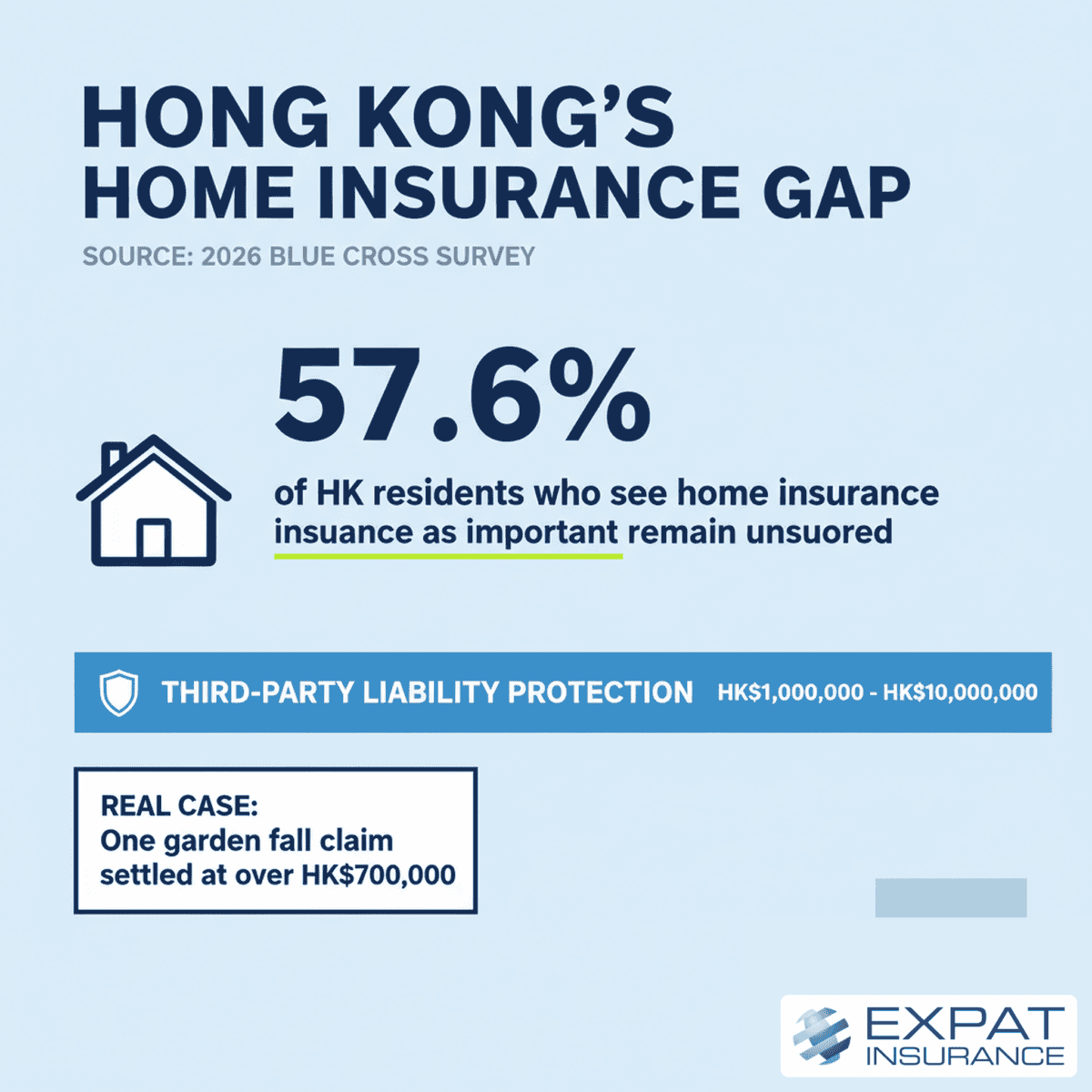
Most home contents policies include third-party liability cover. This protects you if someone is injured in your home, or if you accidentally cause damage to someone else’s property. The Consumer Council’s review of Hong Kong household schemes found legal liability protection ranging from HK$2 million to HK$15 million[3], and comprehensive householder plans commonly carry HK$8 million to HK$10 million[6].
Picture it. You are hosting friends at your flat in Mid-Levels. Someone trips on a loose tile, breaks a wrist, needs surgery and cannot work for two months. Without liability cover, you are personally responsible for medical bills and lost income that can quickly build into a sum far beyond what most people could comfortably absorb. With a contents policy, your liability cover handles the claim: you pay the excess and the insurer covers the rest. We have seen liability claims in Hong Kong settle for sums that dwarf decades of contents premiums.
Whilst Hong Kong is exceptionally safe, with overall crime falling 5.9% in 2025[2], theft, water damage and liability incidents remain genuine risks that a modest annual premium can transfer away.
Your landlord’s policy covers
Related reading
A story from the desk
A couple in their late forties came to us convinced they needed a dedicated policy for a newly upgraded engagement ring. They had a busy life, a mortgage, two children still at school and elderly parents back home they visit each year, and adding another standalone policy felt like one more cost and one more thing to manage. When we looked at their existing home contents cover, the ring simply needed to be specified as an item. It was quicker and cheaper than the standalone route, and it protected everything else they owned as well.
How the Ring Insurance Numbers Actually Work
Let us show you what this looks like in practice. The figures below are indicative only: they illustrate the shape of the decision, and your own quotes will vary with the insurer, your building and your sums insured.
Route 1: standalone ring cover. You insure the ring alone. You get worldwide cover for one item, no protection for anything else you own, and no liability cover. Because single-item jewellery policies carry minimum premiums, small and mid-value rings are proportionally expensive to insure this way.
Route 2: contents policy with the ring specified. Published pricing for a standard Hong Kong contents plan starts at around HK$1,100 to HK$2,170 per year depending on flat size[5], and the Consumer Council found HK$1,000,000 of contents cover available from as little as HK$500 per year[3]. Specifying the ring adds a modest amount on top. For that, you get the ring covered, every other possession covered, liability protection in the millions[3], and extras such as temporary accommodation if your home becomes uninhabitable.
In most cases we quote, the combined route costs less than standalone ring cover and delivers far more. If it is a wedding band you are insuring, our wedding ring insurance cost guide runs through the five cost factors to check.
Want the real numbers for your ring, not the indicative ones?
What About Single-Item Limits on Ring Insurance?
Standard home contents policies include automatic jewellery cover, but with limits, and the limits vary enormously. Across the schemes the Consumer Council compared, per-item limits on household contents ranged from HK$5,000 to HK$300,000, and annual limits on personal effects taken outside the home mostly sat between HK$10,000 and HK$20,000[3].
Outside the home is where rings live, and unspecified items away from home often carry the lowest caps of all: one major plan covers unspecified personal possessions worldwide at HK$10,000 per item[6], and another caps optional worldwide cover at HK$5,000 per item[5]. Specialist insurers make the same point: standard home policies impose per-item and per-category limits and can exclude losses away from home entirely[9].
This is commonly overlooked. If your ring cost HK$40,000 and your policy caps jewellery at HK$15,000 per item[4], you are underinsured by HK$25,000. If the ring is stolen, you receive the cap, not the ring’s value.
The solution is straightforward. You specify the ring on your policy. You provide a valuation certificate from the jeweller or an independent appraiser, the insurer adds the ring as a named item with its own sum insured, and you pay a small additional premium. Now the ring is fully covered, usually without the single-item cap and without the away-from-home restriction. Our guide on why home insurance fails on valuables explains this trap in more detail.
The Cover Wording That Actually Matters: All-Risks vs Named Perils
Two policies can both claim to insure a ring and still behave very differently at claim time, because of one word buried in the wording: whether the cover is written on an “all-risks” basis or a “named perils” basis.
Named perils cover pays out only for the specific causes of loss it lists — typically fire, theft and water damage. That is enough for most household contents, but a ring is different: the most common way an engagement ring is actually lost is not a burglary at all. It slips off in a swimming pool, falls down a drain, or simply goes missing and is never seen again — what insurers usually call mysterious disappearance. A named-perils policy often will not respond to that at all.
All-risks cover, by contrast, insures against any sudden and accidental loss or damage that is not specifically excluded, which is why it is the wording worth asking for by name when you specify a diamond ring on a contents policy. It typically costs a little more than named-perils cover for the same item, but for a ring — worn daily, taken off and put back on dozens of times a week, travelling in pockets and handbags — it is usually the difference that decides whether a genuine loss is actually paid.
When you ask an insurer to specify a ring, ask directly whether the item is covered on an all-risks basis. If the answer is unclear, ask again in writing before you rely on it.
Put all of this together and the practical shape of engagement ring insurance in Hong Kong is simple, even though the wording behind it is not: a proper valuation, a policy specified for all-risks rather than named perils, and a home contents plan that already covers everything else you own. Whether it is a single diamond solitaire, a wedding set bought together, or several family rings insured at once, the same three checks apply every time, and getting them right once tends to matter far more than which insurer’s name is on the policy.
Getting the Ring Properly Valued Before You Insure It
Every route to insuring an engagement ring — specified on a home contents policy, or held on standalone jewellers’ cover — starts with the same document: a proper valuation. Past a certain value, insurers do not settle a claim on a receipt alone. They want a written appraisal that describes the diamond and the setting in enough detail to remove any argument later.
A useful valuation states the carat weight, the cut, the colour and clarity grade, and the metal and setting style, ideally backed by an independent gemological report rather than a jeweller’s own in-store note. Many jewellers in Hong Kong can arrange this at the point of sale, and if yours did not, an independent appraiser can still produce one from the ring itself. Keep the certificate somewhere safe alongside the receipt — if a diamond is ever reset or the ring is resized, the paperwork is what proves what you actually own.
This matters for wedding and engagement rings alike, and it is exactly where ring insurance most often goes wrong: two similar-looking rings can carry very different sums insured once you compare their certificates, and a per-item cap applies to the ring in front of you, not to rings in general. A badly documented ring is the one most likely to be under-settled after a loss.
Some insurers apply the valuation requirement as a simple threshold — below it, a receipt is enough; above it, a certificate is required. Ask where that line sits before you specify the ring, not after a claim. It is also worth asking whether the extra protection sits as a straightforward addition to your existing policy or as a separate rider, since the two are priced and claimed differently. And revisit the valuation over the lifetime of the policy: a ring bought some years ago may be worth meaningfully more today, and cover based on an old figure can quietly under-insure it.
If your ring carries a diamond bought as a loose stone and later set, ask whether the original grading report survived the setting process — a report from a recognised laboratory such as GIA or IGI is what most insurers on our panel actually want to see when you apply for engagement ring insurance, rather than a generic invoice. Where no such report exists, commissioning one before you insure the ring, not after a loss, is the cheaper and simpler order to do things in.
What you should know before you rely on automatic jewellery cover
- ✔ Per-item caps vary from HK$5k to HK$300k across insurers[3], so check yours, don’t assume
- ✔ A common jewellery cap is HK$15k per item[4]
- ✔ Worldwide cover for unspecified items can be as low as HK$5k–10k per item[5][6]
- ✔ Specifying the ring with a valuation removes the cap for that item
- ✔ Keep valuations up to date so a claim pays today’s replacement cost[9]
“I have been using Expat Insurance services for a couple of years for home, life, car insurance and I am very happy with them. The team is very efficient and supportive.”
Pierre · ★★★★★ verified Google review
The Liability Question Nobody Asks
Here is what we find most people don’t realise about liability insurance.
Your potential liability is essentially unlimited. If someone is seriously injured as a result of your negligence and you are found legally liable, the claim can run to medical expenses, lost income, ongoing care and pain and suffering. These add up quickly, and there is no upper limit on what a court can award against you personally.
With home contents insurance, your third-party liability cover steps in. The insurer investigates the claim, handles the legal process, and pays any settlement or judgment up to your policy limit, which across the Hong Kong market ranges from HK$2 million to HK$15 million[3]. This protection alone justifies the cost of a contents policy, even if you didn’t care about insuring your possessions.
And here is the part that surprises people: liability cover matters whether you own or rent your home. Your landlord’s insurance covers the landlord’s exposures, not yours[7]. If you cause damage or injury, you are liable, and a contents policy with liability cover costs far less than defending one claim out of pocket. Do check the excess before you buy: the Consumer Council found liability excesses varying from HK$250 to HK$10,000 between schemes[3].
A story from the desk
We hear the same worry from people at every stage of life, a client in their fifties who assumed it was too complicated to bother with, alongside the occasional newly engaged couple in their thirties. In each case the fix is the same and pleasantly simple: check what you already have, specify the ring properly, and confirm the geography of the cover. Once it is done, it stays done, and you can stop thinking about it.
What Actually Happens If You Need to Claim
Most people insure a ring and never think about the claims side until the ring is gone. The process is more straightforward than people expect, but a few things decide whether it goes smoothly.
Report a loss or theft promptly, and get a police report where the circumstances call for one — insurers on our panel expect this for a stolen ring, and a delay in reporting can complicate an otherwise straightforward claim. From there, the insurer asks for the valuation or certificate on file, which is exactly why keeping that paperwork current matters so much more than people assume when they first take out engagement ring insurance.
Settlement is usually cash up to the sum insured, or replacement of the ring through a nominated jeweller, and either route depends on the certificate matching what is actually lost — the same carat weight, cut and clarity, not simply “a diamond ring of similar value”. This is the single most common reason a ring insurance claim pays out less than the owner expected: the original documentation was vague, so the insurer has room to interpret “equivalent” narrowly.
Wedding and engagement rings are treated identically at claim stage; the label on the ring makes no difference to how a panel insurer such as MSIG or Zurich assesses the loss. What matters is the same thing that mattered when you first arranged cover — the certificate, the sum insured, and whether the item was specified correctly in the first place. Get that right at the start, and the claim itself is the easy part.
How to Get Your Engagement Ring Properly Covered
If you are arranging engagement ring insurance in Hong Kong, here is what we recommend.
Five steps to properly protected
Get a valuation. Ask your jeweller for a valuation certificate stating replacement value, metal, stone quality and carat weight. Independent appraisers can value the piece if you didn’t get one at purchase.
Review your current policy. Find the single-item jewellery limit. If the ring exceeds it, ask your insurer to add it as a specified item.
Compare the real cost. Quote both routes. Factor in liability cover, all-possessions cover and temporary accommodation, not just the ring line.
Understand the excess. Excesses vary widely between schemes[3]. A cheap premium with a high excess may not be the better deal.
Read the exclusions. Common jewellery exclusions include unexplained loss, wear and tear, stones lost from settings, and damage during professional cleaning or repair.
One more thing we have noticed: insuring a ring is often a gateway to broader protection. Once you list your electronics, watches, instruments and heirlooms, most renters discover their possessions are worth several hundred thousand dollars, far more than they assumed. A contents policy covers the lot, with the ring specified on top, and premiums start at a few hundred dollars a year for HK$1,000,000 of cover[3].
Protecting your ring with the right engagement ring insurance doesn’t have to be complicated or expensive. The key is understanding your options and choosing the structure that fits your situation. And if you are not sure, talk to someone who can explain your options without pushing you towards a specific product. That is what we do at Expat Insurance.
Insuring More Than One Ring
An engagement ring rarely stays the only ring in the picture for long. A wedding band follows, and for some households a family heirloom ring joins the collection later. Each of these can sit on the same contents policy, specified separately, rather than needing its own standalone arrangement.
An heirloom ring deserves particular care, because there is often no receipt to fall back on — only a family history and, if you are fortunate, an older certificate. An independent valuation solves this: it re-establishes the carat weight, cut and clarity in a form an insurer will accept today, regardless of how the ring was originally acquired. Treat an inherited diamond ring exactly as you would a newly purchased one for insurance purposes, and get it valued before assuming the cover already extends to it.
Two or three rings specified on one contents policy is usually simpler, and often cheaper, than separate standalone jewellery insurance for each. The insurer already has your valuations on file, your premium reflects the combined sum insured, and a single claim on any one ring is handled the same way as it would be if it were the only piece of jewellery you owned.
If you are weighing up cover for the first time, it helps to think about the whole picture rather than the single ring in isolation. An engagement ring insurance decision made in isolation from the rest of your possessions is rarely the cheapest or the most complete answer, and the numbers above show why: the incremental cost of adding a diamond ring, or two, to an existing contents policy is consistently smaller than a standalone policy priced on that ring alone. Ask your adviser to run both figures side by side before you decide, so the choice is based on your actual numbers rather than an assumption about what insurance for rings is supposed to cost.
The same logic extends to a matching set bought together — an engagement ring and its wedding band, or two rings bought as a pair for an anniversary. Insurers on our panel are used to specifying multiple rings on one schedule, and the paperwork is no different for two diamond rings than it is for one: a valuation for each, a combined sum insured, and one premium adjustment rather than two separate policies to manage and renew.
Frequently Asked Questions
Is my ring already covered by my home contents policy?
Possibly. Standard Hong Kong contents policies include jewellery cover up to a per-item cap, commonly around HK$15,000[4], though limits vary widely between insurers[3]. If your ring is worth less than your cap, it is likely already covered at home. Check the away-from-home limit separately.
What if my ring is worth more than the single-item limit?
Specify it. You provide a valuation certificate, the insurer names the ring on the schedule with its own sum insured, and the per-item cap no longer applies to it. The additional premium is modest compared with standalone cover.
Do I need a valuation certificate?
Yes, for any specified item. It proves the replacement value and describes the piece. Keep it up to date: specialist insurers stress that current appraisals and agreed values give you the strongest safeguard against underinsurance at claim time[9].
Is the ring covered when I travel outside Hong Kong?
Once specified, cover is normally worldwide. Unspecified items rely on the policy’s personal possessions section, which can be capped as low as HK$5,000 to HK$10,000 per item[5][6], so a valuable ring should always be specified.
I rent my flat. Does my landlord’s insurance protect my ring?
No. Landlord policies cover the building and the contents the landlord owns[7]. Your possessions and your personal liability are only protected by your own contents policy[8].
What is usually excluded from jewellery cover?
Typical exclusions include unexplained or mysterious disappearance, wear and tear, loss of a stone from its setting unless the whole item is lost, and damage during professional cleaning or repair. Always read the exclusions list before you buy so a claim never surprises you.
How We Work With You
We Talk
We explain who we are, what we do, and what we will do for you specifically. We answer every question you have about contents cover and protecting your ring.
We Educate
We research the market and bring you quotes and options tailored to your situation, whether you are in a village house, an older building or a standard flat.
You Decide
We walk you through each option, the excess structures and the differences between policies. The choice is always yours, made with full information.
We Stay With You
Once your policy starts, we review your coverage with you at least once a year. Your needs change over time, and your cover should change with them.
Speak with us today
No pushy sales, just a friendly conversation about protecting your ring and everything else that matters. We will review your situation and explain your options clearly.
Phone: +852 3563 9771
Email: [email protected]
Office: Suite 701, Connaught Commercial Building, 185 Wan Chai Road, Wan Chai, Hong Kong

Insurance content · Expat Insurance Hong Kong
Expat Insurance Editorial Team
Articles from Expat Insurance Hong Kong are prepared by our team of brokers and insurance specialists, drawing on more than 60 years of combined experience arranging cover for expats and local families across Hong Kong.
Sources
- Hong Kong Police Force, Law and Order Situation in Hong Kong in 2025: 816 burglary cases, down 33.1%, a new historical low since 1969
- HKSAR Government press release, Law and Order Situation in Hong Kong in 2025: overall crime down 5.9% to 89,137 cases
- Consumer Council, study of 22 home insurance schemes: premiums of HK$500 to HK$1,480 for HK$1,000,000 contents cover, per-item limits of HK$5,000 to HK$300,000, personal effects limits mostly HK$10,000 to HK$20,000, legal liability of HK$2 million to HK$15 million, excesses of HK$250 to HK$10,000
- MSIG Hong Kong, What does home insurance cover: contents cover up to HK$1,000,000, valuables up to HK$15,000 per item, personal liability up to HK$8,000,000
- MSIG Hong Kong, iHome Insurance plan details: contents premiums from HK$1,100 to HK$2,170 by flat size, worldwide personal possessions option capped at HK$5,000 per item
- Zurich Insurance Hong Kong, Breezy Home Insurance Plan (Householder): contents cover up to HK$1,250,000, unspecified worldwide possessions HK$10,000 per item, legal liability up to HK$10,000,000
- Zurich Insurance Hong Kong, Breezy Home Insurance Plan (Landlord): cover applies to contents owned by the landlord, plus owner liability and loss of rent
- MSIG Hong Kong, Differences Between Landlord and Tenant Insurance: tenant cover protects legal liability for the landlord’s contents, fixtures and appliances
- Liberty Hong Kong, Luxury jewellery insurance: standard home policies impose per-item and per-category limits, may exclude losses away from home, and up-to-date appraisals protect against underinsurance
Insurance products, terms, limits and premiums change over time, and figures described as indicative are illustrations rather than quotes. This article is general information only and is not personal advice. Please contact us directly for current information and recommendations tailored to your situation.